
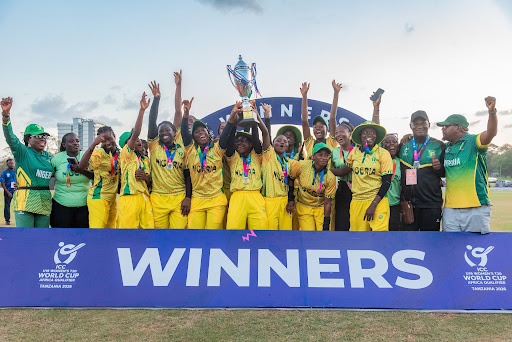
HOW THE GIRLS BROKE THE CYCLE
There is a pristine beauty that belongs exclusively to the morning of a cricket match before the first spikes scar the sunbaked turf. And between the clean white lines promising absolute fairness, everything is possible. Yet, as any follower of the game will tell you, the true test of a pitch - and that of a team - is how they weather the afternoon heat when the surface cracks, the ball stays low, and the pressure hardens like clay under a tropical sun.
In Dar es Salaam, Nigeria’s Junior Female Yellow Greens did not just walk out onto the field; they commanded it. They completed an astonishing, unblemished campaign at the ICC U19 Women's T20 World Cup Africa Qualifier to lift the trophy and book Africa’s sole qualification ticket to next year’s global showpiece in Bangladesh and Nepal. To go entirely undefeated in a tournament where the pitches tested every ounce of technique is nothing short of a masterclass.
THE ANATOMY OF A CHAMPION TEAM
Every cricket tournament is an unblinking mirror held up to a country’s grassroots structures. This historic victory is the ultimate validation of the high-performance programs and training camps meticulously laid out in Benin, Abuja and Lagos by this current administration of the Nigeria Cricket Federation. A framework that carved a pathway for women, a platform that allowed girls to fail in the safe environment of local leagues so that they don’t fail on the world stage. A program that was deliberate about the selection of the coaching crew and auxiliary hands. Under the direction of this expert technical crew, these girls showed tactical maturity that defied their biological clocks.
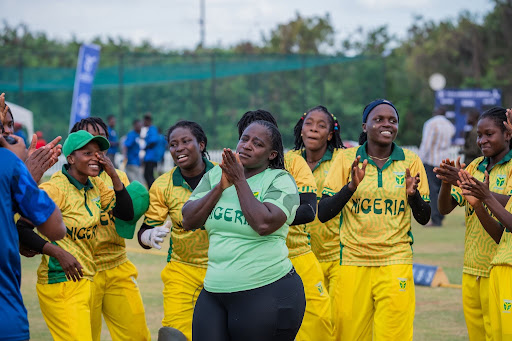
They conquered Uganda, dismissed Malawi, out-muscled the Tanzanian hosts in the group stage, out-thought Rwanda in the semi-final and then stood like an immovable concrete wall against a fierce Zimbabwean side in a breathless final. Defending a modest total of 98 runs on a testing surface, they squeezed the life out of Zimbabwe’s chase to secure a dramatic 4-run win with only one ball left in the match. That is not just cricket; that is pure, unadulterated character.
I have stood on enough dusty grounds in Lagos, Ibadan and Benin to know what a Nigerian cricket team looks like when it is afraid. Afraid of the scoreboard. Afraid of the next over. Afraid of having to bat for 20 overs without hiding behind a bowler. Afraid of being expressive without upsetting the dugout. Out there in Tanzania, Nigeria was not afraid. In Dar es Salaam, the Junior Female YellowGreens were not afraid.
As the competition approached, many people had said “send the girls to Tanzania and let them learn…there are bigger African teams in the competition so it will be a good place for them to learn”. But, the girls said “we came to teach”. Not only did the Junior Female YellowGreens dish out cricket lessons in Dar es Salaam, they came back with the ticket to Bangladesh/Nepal 2027.
Unbeaten, 6 wins from 6 games, the ICC U19 Women’s T20 World Cup Africa Qualifier champions showed to the world that the first time was not a fluke, neither was it luck. Going an entire tournament without tasting defeat among a line-up that paraded the likes of Uganda, Tanzania and Zimbabwe – that is not luck. That is work – hard work.
And the most important part? They didn’t get there by bowling teams out for 60 and praying. They got there by batting. When the final wicket fell, skipper Chukwuonye wept open tears of joy on the outfield. For these girls, the sky is no longer a limit; it has simply become their batting crease.
Let that sink in.
THE STORY OF THE TOURNAMENT: WE LEARNED TO BAT, FINALLY
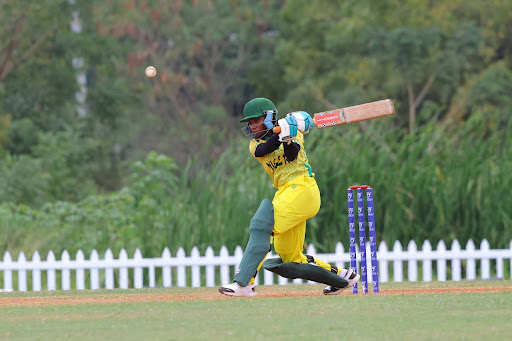
For many years and through many generations, several people have echoed the same sentiment: Nigeria is a country of bowlers. It is true. We hand a girl a tennis ball at age 9 and tell her to “bowl fast”. We hand her a bat at 15 and say “just don’t get out”. This team tore up that manual. Game 2 vs Malawi tells you everything. A convincing score of 152/7 in 20 overs whispered something to the nation that we had not yet realized.
We have seen U19 qualifiers where 92 was a defendable total. Now Nigeria is posting 150 and it doesn’t even feel like enough. Shola Adekunle’s 32 off 27 set everything up. No wild swings, no risky shots, no needless gambles. She picked gaps, ran hard twos and made the Malawi captain move her field 4 times in 6 overs. That’s senior cricket. Watching her mature into the cricketer she is today really warms the heart and promises a bright future for the game in the country.
Then, Omosigho Eguakun’s 26 and Beauty Oguai’s 26 came and did the dirty work in the middle. Singles. Rotation. No dot-ball clusters – something that a typical Nigerian team has been guilty of for many decades. And then the captain walked in. Christabel Chukwuonye blasted 20 off 12, including 2 fours and 1 six at a strike rate of 166. In a U19 with qualification on the line, she hit a six and turned to her dugout like she had done it 100 times. That is belief. That is what happens when you stop telling girls to “just survive 10 overs”.
THE BOWLING: STILL OUR FIRST LANGUAGE
Of course the bowling was good. It is Nigerian. In a journal that had many characters, Jennifer Godwin was the headline. Her 4 wickets for a miserly 5 runs in 2.3 overs vs Malawi had the Malawi batters playing for a draw. She had control far ahead of her years on that Dar es Salaam pitch, hitting the deck with conviction and determination. 4 wickets, 5 runs - that’s not a spell, that’s a statement.
Shola Adekunle backed it up with 2 wickets in 4 overs which included a maiden. An all-round performance that our senior team has been begging for. And after we bowled Malawi out for 58, the plans became clear to everyone: new ball wickets, middle overs squeeze, death over strangulation.
THE REPORT CARD: BREAKING DOWN THE CHAMPIONSHIP BLUEPRINT
To truly understand how this historic trophy was carved out of the Tanzanian clay, we must look past the raw scorelines and examine the machinery of the squad. Here is a definitive, department-by-department tactical review of the Junior Yellow Greens' flawless campaign.
Batting: The Dawning of Depth
For years, the Achilles' heel of Nigerian women’s cricket at all levels has been an agonizing reliance on one or two solitary figures to carry the entire weight of the innings. If the openers fell early, the house of cards collapsed. In Dar es Salaam, however, we witnessed a profound structural shift. For the first time in our history, we didn't just have two batters out there fighting the elements - we had five.
The batting unit functioned with an unprecedented layer of insulation. Omosigho Eguakun deservedly grabbed the headlines and the Best Batter accolade with her metronomic, stabilizing knocks. But the real story was the collective resistance. When the top order stumbled against the hosts or ran into the Zimbabwean buzzsaw, the middle and lower-order links held firm. Contributions from Christabel Chukwuonye, Beauty Oguai, Jessica Bieni, and Deborah Bassey meant that opposition captains could never settle into defensive fields after an early breakthrough. There is still technical hardening required before they face the high-octane pacers and mystery spinners of Bangladesh and Nepal next year, but this newly discovered depth is a massive leap forward.
Bowling: World-Class Suffocation
If batting wins you matches, it is your bowling attack that hoists the silverware. This department remains the undisputed jewel in Nigeria’s cricketing crown. Make no mistake: Nigeria’s bowling unit is not just one of the finest in Africa. At this age-grade level, it is genuinely world-class.
To consistently defend sub-100 totals in modern T20 cricket requires an almost miraculous level of execution. It demands bowlers who can land the ball on a bottle cover, read the wind, exploit the pitch variations and refuse to bleed boundaries when the opposition is swinging for the hills. Peace Usen’s magnificent, match-winning spell of 3 for 19 in the final was a clinic in high-pressure execution. Supported by the relentless accuracy of Jennifer Godwin and Annointed Akhigbe, the Nigerian attack simply choked the life out of every chase. They didn't just take wickets; they created a claustrophobic atmosphere of dot balls that drove opposition batters to tactical ruin. On any pitch in the world, this bowling group will give Nigeria a fighting chance.
Fielding: Sharp, Athletic, Committed
You can tell everything you need to know about a team's internal culture by watching them in the field when the ball isn't going their way. Nigeria's fielding across the tournament was a breath of fresh air. They were sharp, athletic and fiercely committed to every blade of grass.
In the stifling heat of Dar es Salaam, there was no sign of lethargy. Ground fielding was handled with clean, decisive takes and the boundary riders cut off certain fours with desperate, body-on-the-line grabs. The inner ring maintained a fierce intensity, piling psychological pressure on batters trying to steal quick singles. While a few high pressure chances went begging in the late overs of the tournament (as is natural with junior cricketers) their overall athleticism and desperate hunger to protect every single run became the definitive safety net for their bowlers.
Leadership: The Stateswoman at the Helm
Captaincy at the Under-19 level is a heavy cross to bear, especially when you are carrying the dreams of a nation chasing a second consecutive World Cup ticket. Yet, Christabel Chukwuonye led this side with the tactical nuance, emotional intelligence and calm composure of a seasoned senior international player.
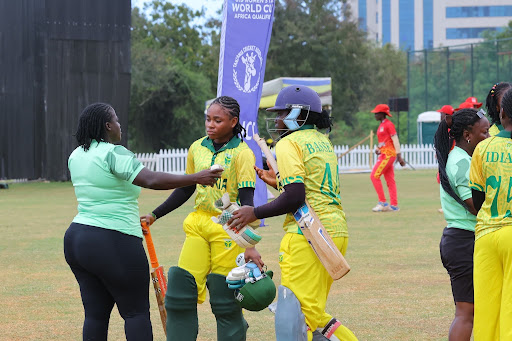
Leadership is not just about setting fields; it is about managing emotions when a game is slipping away. In the grand finale, with Zimbabwe launching a dangerous counter-attack and the boundary margins shrinking, Chukwuonye never panicked. She rotated her bowlers with absolute precision, altered her fields dynamically based on the match situation and kept her team's collective heart rate down. Her vital contribution of 21 runs off 19 balls under intense pressure earlier in that match showed she is a leader who steps into the fire first. When she wept on the turf after the final ball, it wasn't just relief, it was the exhaustion of a young general who had successfully maneuvered her troops through a historic campaign.
As always, our message to the NCF would be to not let these girls go back to their states and disappear. They should be centralized and motivated to do even more. More to that, they should be made to play even more games against senior teams. Beyond 2027 when these girls would have gone on to even more exploits in Bangladesh, they should be ferried into the Female YellowGreens to continue from where they would have left off.
To our unbeaten, World Cup bound Champions, huge congratulations to you for breaking the stereotype of Nigeria being a bowing nation. Now that the cycle of dominant continental nations is breaking, many more enthusiasts are here for it. What a time to be alive!